Key Takeaways:
- Z Fold 8 wins if your life revolves around multitasking, productivity, consuming media on a tablet-grade screen, or using Samsung DeX
- Z Flip 8 wins if you prioritize pocketability, fashion-forward design, social content creation, or a lighter daily carry
- Both run Snapdragon 8 Elite, share the same camera architecture, and cost nearly the same once you compare equivalent storage tiers
- The real deciding factor is not specs on paper but how your daily movement pattern maps onto two completely different hardware philosophies
Let me be straight with you for one second. If you walked into a store, looked at these two phones, and still could not tell which one was designed for your actual life, that is not your fault. Samsung's marketing machine is intentionally blurry on this point because both phones have the same flagship chip, the same Samsung camera processing pipeline, and almost the same starting price. But underneath that surface similarity, these two devices belong to two entirely different universes of daily experience.
This guide does not dump a spec sheet on you. Instead, it walks through the real-world scenarios that separate a happy Z Fold 8 owner from a frustrated one, and the same for the Z Flip 8. By the end, you will not be comparing numbers. You will be comparing your Tuesday mornings.
The Honest Spec Picture
Before we get into lifestyle, let us clear the technical floor so nobody can claim we are hiding anything.
Both phones launch with the Snapdragon 8 Elite processor. That means identical CPU, identical GPU, identical AI acceleration. Benchmark scores will be virtually the same. Where they diverge is in the hardware around that chip.
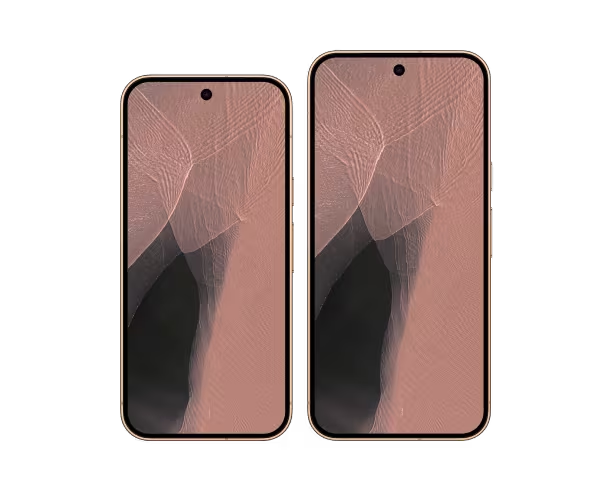
The Z Fold 8 opens into a 7.6-inch inner display with a resolution of 2160 x 1856 pixels, running at an adaptive 1-120Hz. The cover screen on the outside is a 6.2-inch panel. It weighs 253 grams, which is roughly the weight of a small notebook and some candy bars combined. The battery sits at 4,400mAh.
The Z Flip 8 has a 6.7-inch inner display (2280 x 1080, 1-120Hz) and a 3.4-inch cover screen that has finally grown large enough to be genuinely useful for replies and notifications. It weighs just 187 grams. The battery is 4,000mAh. Same charging speeds on both: 25W wired, 15W wireless.
Camera-wise, the Z Fold 8 carries a 50MP main, 12MP ultrawide, and 10MP telephoto with 3x optical zoom. The Z Flip 8 drops the telephoto and instead gives you a 50MP main and 12MP ultrawide. The front-facing cameras are both 10MP. This is not a dealbreaker, but if you zoom in a lot, the Fold wins.
Now the specs are out of the way. Everything after this is about how these differences feel in real hands during real days.
Buy the Z Fold 8 If Your Life Runs Like This
The Fold is not a phone that happens to fold. It is a small tablet that happens to fit in your pocket when closed. That framing changes everything.
1. You live inside apps, not on top of them
If your morning routine begins with checking email, then Slack, then a spreadsheet, then a video call, all before leaving the house, the Z Fold 8 turns that juggle into a single glance. Samsung's split-screen and flex mode let you run three apps simultaneously across the inner display. The 7.6-inch canvas is close enough to an iPad Mini that you can genuinely edit documents, annotate PDFs, and participate in video calls without reaching for a laptop.
One UI 8 added app pair shortcuts and more flexible window ratios. You can now run a messaging app in a tall strip on the left while a browser takes up the rest of the space. This is not a gimmick; it is a workflow upgrade for anyone who uses their phone to do real work. We covered the full list of One UI 8 foldable features here if you want the complete breakdown.
2. You consume serious media
Streaming a movie on the Z Fold 8 inner screen is almost a tablet experience. The aspect ratio is closer to 16:10 than a regular phone, which means less letterboxing. YouTube, Netflix, and local video files all fill the screen beautifully. Fold it halfway, prop it on a table, and watch hands-free in flex mode. It becomes a flatbed viewer that stands on its own.
If your weekends involve catching up on shows while commuting, bingeing YouTube cooking tutorials in the kitchen, or watching replays at the gym, the Fold transforms every flat surface into a small theater.
3. You carry a laptop and resent it
Samsung DeX has matured to a genuinely useful desktop interface. Plug the Z Fold 8 into a monitor via HDMI, and you get a PC-like environment with windowed apps, keyboard, and mouse support. For meetings, travel days, or coffee shop sessions, your entire computing setup lives inside a device that fits in your jeans pocket when not in use.
This is the specific scenario where the Fold saves you money over time. You might find yourself reaching for your MacBook or Windows laptop less, and that compounds into something real.
4. You want the best foldable camera setup
The telephoto lens on the Z Fold 8 is not a throwaway addition. A 3x optical zoom lets you capture portraits, stage events, or distant subjects without digital crop noise. For a creator who shoots product shots, event coverage, or family photos primarily with their phone, that optical reach matters more than most review videos admit.
Buy the Z Flip 8 If Your Life Runs Like This
The Flip is the phone that respects the fact that you hold a phone for three seconds at a time between real life events. It does not try to replace your laptop. It insists on being the best possible phone you can carry.
1. You are tired of giant slabs in your pocket
A Z Flip 8 folded down is about the size of a compact powder compact. It slides into jean pockets, clutch bags, and bike jersey pockets without the slab-in-your-side discomfort that comes with phablet-sized phones. Gyms, runs, dates, and travel outfits all benefit from a device that disappears into whatever you are wearing rather than announcing its presence with a lump.
At 187 grams, you can hold it for long reading sessions without the wrist fatigue that comes with heavier devices. For anyone with small hands or a minimalist lifestyle, this is not a minor preference; it is a daily comfort decision.
2. You live in social media, not spreadsheets
The Z Flip 8 was built with content creation in mind. The large cover screen lets you take selfies, shoot vertical video, or film photos hands-free by folding the phone at a 90-degree angle on a table or ledge. No tripod, no awkward reaching, no charlie-horse arm pose.
Instagram Stories, TikTok videos, and BeReal snaps all benefit from a setup that lets you frame yourself naturally without you having to hold the camera like a selfie stick. For creators, influencers, and anyone who documents their life visually, the Flip's form factor is an active creative tool, not just a device that plays media.
3. You value style and personalization
Let us be honest: the Flip is the fashion phone. It comes in more colors, more finishes, and more customization options than the Fold. The cover screen can be customized with widgets, clocks, and photo frames that show when the phone is folded. You butter your personality all over this device in a way you simply cannot with a slab phone.
When people see you using the Flip, they notice. When they see the Fold, they nod politely. If you want a phone that starts conversations at parties, this is the only foldable that reliably delivers that.
4. You want a lighter repair story
The Z Flip 8 scored a 6 out of 10 on iFixit, which is moderate repairability but actually better than most foldables. We went into the full repairability breakdown in our iFixit analysis here. The bottom half of the device opens up for easier battery and module access. When you drop $1,000 on a phone, knowing that battery replacement does not require complete teardown is psychological comfort worth paying for.
Where They Actually Collide
We need to talk about the overlap zone, because this is where most buyers get stuck and make an expensive mistake.
Price: The Z Fold 8 starts at $1,799 for 256GB. The Z Flip 8 starts at $1,099 for 256GB. That is a $700 gap, which is significant. The Fold is not just a bigger foldable; it is positioned as a premium productivity device with the price to match.
Battery life: The 4,400mAh battery in the Fold sounds like an advantage until you factor in the 7.6-inch screen. Heavy multitasking on the inner display draws power fast. The Flip's 4,000mAh, driving a single 6.7-inch display, actually delivers comparable all-day endurance for most users because the workload is less demanding.
Build quality: Both have Armor Aluminum frames and Gorilla Glass Victus 2 on the outer glass. Both are IPX8 water resistant (same 1.5 meters for 30 minutes rating). The hinge on both now uses a slimmer interlocking gear mechanism that reduces the visible gap when opened. Samsung has closed the durability gap significantly, but both will still develop hinge crease awareness over 12 to 18 months of daily use.
Price and Value Over Time
Buying a foldable is not a one-year decision. These are $1,000+ devices that most people keep for 24 to 36 months.
The Z Fold 8 at $1,799 asks: can you replace a laptop with this? If the honest answer is yes, the price drops in half in your mind. If you still need a laptop, the Fold becomes a very expensive companion to another device, which makes it harder to justify.
The Z Flip 8 at $1,099 asks: can this be the best phone you have ever owned? The answer is almost certainly yes, regardless of how you use it, because the specs are genuinely flagship-grade and the form factor is genuinely fun. The value case here is simpler and stronger.
The Lifestyle Test
Here is the final framework. Instead of more specs, run through these four questions honestly.
How many apps do you keep open at the same time? If the answer is three or more regularly, the Fold's inner canvas is your answer. If you close one app before opening the next, you are buying real estate you will not use.
How do you commute or travel? If your commute involves a train, a bus, or any flat surface where you can prop up a device, the Fold in Flex Mode justifies itself. If you move standing up most of the time, the Flip in your pocket causes zero friction.
Is your phone your primary camera? If you chase optical zoom, shoot videos in portrait, or capture wide-angle landscapes, the Fold's third camera lens is not a bonus feature; it is a different category of camera.
How much do you customize your device? The Flip is the canvas. Colors, cases, accessories, and cover screen widgets transform it into a physical expression of taste. The Fold is a tool. It looks like a tool. It functions like a tool. There is nothing wrong with that if tools are what you need.
A Quick Note on Existing Foldable Owners
If you are upgrading from a Z Fold 5 or earlier, the Fold 8 is a meaningful step forward in hinge slimness, cover screen size, and processor efficiency. Feels like a proper generational upgrade. If you are upgrading from a Z Flip 5 or earlier, the bigger cover screen on the Flip 8 changes how you interact with the device when closed. Many Flip 5 users tell us they rarely used the cover screen before; the Flip 8 version is large enough that they actually do.
Conclusion
There is no wrong answer between the Z Fold 8 and the Z Flip 8, but there is a wrong answer for you specifically. The Fold wins when your days run through multiple complex apps simultaneously, when you commute with flat surfaces available, or when you have genuinely accepted your phone as a partial laptop replacement. The Flip wins when you care more about what fits in your life than what replaces it.
Samsung built two different philosophies into glass and aluminum. Your job is simply to be honest about which philosophy matches your Tuesday morning.
Still torn? If budget is the only variable keeping you from either, remember this: Samsung runs trade-in promotions aggressively around launch season. The effective price gap between these two devices narrows considerably when you factor in your current phone's trade-in value. We broke down the upgrade math in a way that actually accounts for real-world trade-in values, not just sticker prices.
Which foldable fits your daily routine better? Share your honest app usage in the comments.
Frequently Asked Questions
Is the Galaxy Z Fold 8 worth the extra money over the Z Flip 8?
If you regularly run three or more apps simultaneously, use Samsung DeX for desktop productivity, or rely on the telephoto camera for zoom shots, the Fold 8 justifies its premium. If most of your phone time is messaging, social media, and casual browsing, the extra money buys screen real estate you will not use consistently enough to notice.
Can the Z Flip 8 replace my main phone?
Yes. The Z Flip 8 runs the same Snapdragon 8 Elite chip, has flagship cameras, 5G, and the full One UI 8 experience. The 6.7-inch inner display is large enough for everything most people do. The only limitation is multitasking; you cannot run apps side by side at the same scale as the Fold.
Which foldable lasts longer, the Z Fold 8 or Z Flip 8?
Based on current foldable lifespan data, both should reach 200,000 fold cycles with proper care. The Flip 8 iFixit score of 6/10 is slightly more repair-friendly than the Fold 8. In practice, longevity depends more on how gently you handle the hinge and whether you use a protective case than on the model you pick.
Do apps work well on the Z Fold 8 inner display?
Most popular apps do. Samsung has optimized over 5,000 apps for foldable screens, and developers are increasingly building for large-screen ratios natively. Some apps letterbox, but this is improving with every Android version. Multi-tasking workflows with split-screen and flex mode work reliably across Samsung's own apps and Google's suite.